
What Overflowing Gutters Are Trying to Tell You: A Homeowner’s Diagnostic Guide
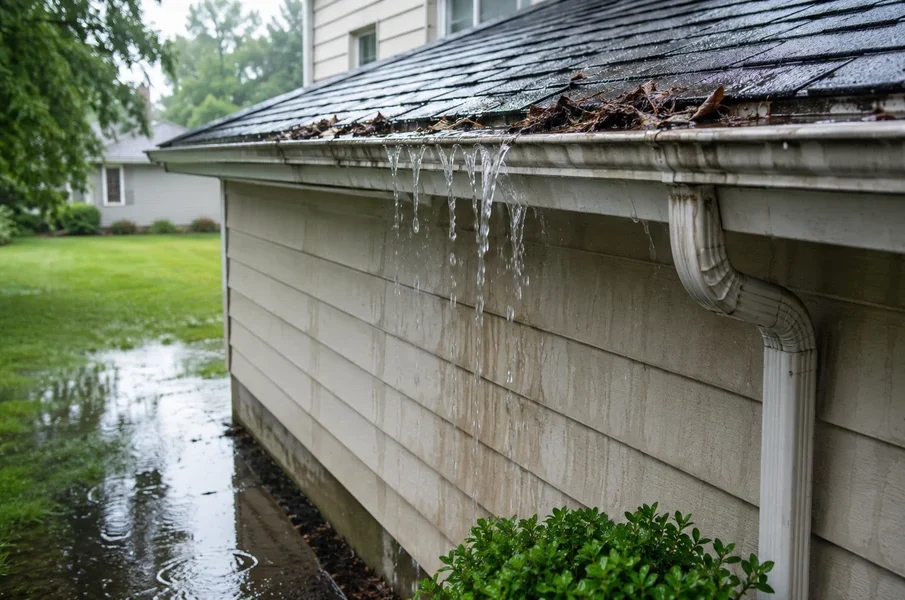
An overflowing gutter may look like a simple maintenance problem, but the location and timing of the overflow can tell you a great deal about what is happening inside the drainage system.
Sometimes the cause is straightforward: leaves or other debris are preventing water from reaching a downspout. In other cases, the gutter may be holding water because an outlet is blocked, a section has shifted, or drainage farther down the system is restricted.
Instead of treating every overflow the same way, homeowners can use a few basic observations to narrow down the likely cause before deciding what to do next.
Start by Watching Where the Water Overflows
If possible, observe the gutters during moderate rainfall while remaining safely at ground level.
The location of the overflow is often more useful than the amount of water coming over the edge.
Water spilling across a long section of gutter may indicate that debris has accumulated throughout the channel. Leaves, twigs, seed pods, and other material can reduce the space available for rainwater and slow its movement toward the outlet.
Overflow concentrated near one end of the gutter may point instead to an obstruction around the outlet or inside the downspout.
You may also notice that one gutter section drains normally while another fills quickly. That difference can help isolate the part of the system that deserves closer inspection.
The goal at this stage is not to diagnose every possible defect from the ground. It is simply to determine whether the problem appears widespread or concentrated in one area.
When the Problem Is a Blockage, Not a Broken Gutter
Visible debris is one of the most straightforward explanations for poor gutter performance.
A layer of leaves across the gutter can slow water movement, but the less obvious trouble spot is often the outlet where the gutter connects to the downspout. Debris can collect around this relatively narrow opening and restrict drainage even when other sections appear reasonably clear.
Downspouts can also become obstructed below the point that is visible from the ground.
When safe access is difficult or debris appears packed into outlets or downspouts, using a professional gutter cleaner can be a practical way to remove the buildup and check whether water is moving through the drainage system properly.
After debris is removed, the next rainfall-or a controlled water-flow check performed safely-can reveal whether the blockage was the entire problem.
If overflow continues afterward, it may be time to look beyond cleaning.
Pay Attention to Gutters That Hold Water
A gutter does not need to overflow dramatically to signal a problem.
Standing water that remains well after rainfall can suggest that water is not reaching the outlet efficiently. Debris may be responsible, but the gutter’s position can also matter.
A section that has shifted or sagged may create a low point where water collects instead of continuing toward the downspout. From the ground, this sometimes appears as a gutter line that is visibly uneven.
The important distinction is that removing debris will not correct every drainage issue.
Cleaning gives you a clearer system to evaluate. If water continues collecting in the same location after the channel and outlet are clear, the gutter itself may require adjustment or repair.
That is why diagnosing drainage problems works best as a process rather than assuming every symptom has the same cause.
Look Beyond the Gutter Edge
Some of the most useful warning signs appear below the gutter rather than inside it.
For example, water regularly spilling over one location can leave a pattern on the siding or repeatedly soak the ground beneath that section. Water emerging from an unexpected joint can point to a connection or leak that deserves inspection.
The downspout discharge area is equally important.
Once water enters a downspout, it still needs a clear route away from the structure. If water backs up, escapes from a connection, or does not appear to be draining normally during rainfall, the problem may exist somewhere within that drainage path.
Homeowners should also avoid assuming that a gutter is working simply because no debris is visible from below. Some of the most important restrictions occur around outlets and inside downspouts, where a ground-level inspection cannot reveal everything.
Know When Observation Is Better Than DIY Intervention
Gutter problems often tempt homeowners to reach immediately for a ladder.
That is not always necessary.
A useful first step is documenting what happens during rainfall. Note where overflow begins, whether it happens immediately or only after sustained rain, which downspouts appear active, and whether the same locations cause trouble repeatedly.
These observations can make later maintenance or inspection much more targeted.
If a gutter can be reached safely using appropriate equipment and the problem is limited to obvious surface debris, routine maintenance may be straightforward for some homeowners. But steep roofs, multi-story sections, unstable ground, difficult access, and concealed downspout blockages can turn a simple maintenance job into an unnecessary safety risk.
Knowing when not to climb is part of responsible home maintenance.
Conclusion
Overflowing gutters are symptoms rather than diagnoses.
Where the water spills, how quickly it happens, whether the gutter retains water afterward, and what happens at the downspout can all provide clues about the underlying problem.
Start with observation. Determine whether debris or a localized blockage is likely, clear the system where it can be done safely, and then see whether normal drainage returns.
If the same problem remains after the gutter is clear, the issue may involve alignment, connections, leaks, or another condition that requires closer inspection.
Treating overflow as useful information-not simply an inconvenience-makes it easier to address small drainage problems before they become larger maintenance projects.